Cuntz positive organ · a model to inspect
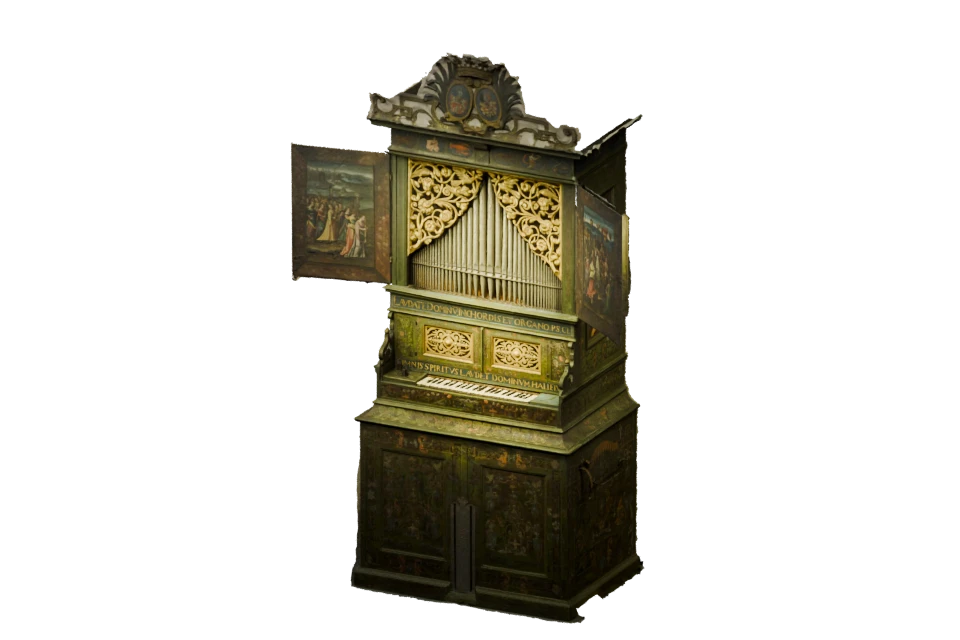
The 3D view loads only when requested. Download: 3.9 MiB · light preview.
Drag to rotate; use + and − to zoom. Keyboard: focus the model and use arrow keys, or use the view buttons above. Page scrolling stays available.
This geometry represents the Cuntz organ. Rotating or simplifying it changes a digital view or file, not the physical instrument. Its scale has not been independently calibrated.
Understand the identity distinction →These modeled keys are visible geometry. This preview does not play the instrument, and no key-to-pipe measurement mapping is asserted. A playable package needs additional data and software behavior.
Understand profiles and capabilities →Rotate the model to inspect its represented structure. The light preview simplifies the geometry; “More detail” loads the earlier display derivative. Both derive from the released GLB. Neither is a calibrated survey or a reconstruction certified as the instrument’s state in 1610. Keyboard and stop controls are visual geometry here; this viewer does not play the instrument.
Recording, data curation, VAO production and maintenance: Dominik Ukolov; measurements: Philipp Hosbach; TASTEN and DISKOS coordination: Dr. Heike Fricke; project leadership: Prof. Dr. Josef Focht; restoration: Markus Brosig and Veit Heller; institution: Leipzig University; hosting: Musikinstrumentenmuseum der Universität Leipzig. · CC BY-SA 4.0
Source, changes & file identity
Web display derivative: texture resized to at most 2048 pixels and encoded as JPEG (quality 85); duplicate and unused resources removed and identical vertices welded; meshopt compression with quantization. No historical geometry or physical scale was independently validated. Source realization: urn:musixplora:4010243:cuntz-positiv:realization:model-runtime:4010243_segmented_03b2. Source SHA-256: 19527c2188b08d8536f00299a76c0c73490748298e6cb4dfa07d5b1b684793f5. The poster is a rendered view prepared from the same display geometry.
Detailed display SHA-256: 6f0dd1a5ea58403da979de9b95ce1232aaf38671d1756ad127a404ba4ae91b47
Light preview derived from the web display model: attribute-aware mesh simplification targets 25% of triangles with an error setting of 0.01, UV weights of 0.5 and normal weights of 0.1; seam collapses are permitted, followed by Meshopt quantization and compression. Texture and node identities are retained. These are algorithm settings, not a bound on historical or physical accuracy.
Light preview SHA-256: e4a393742e76bfe97a0ea1c140832e4309100aa74e1ff8f0b94ec7b7c7688d87