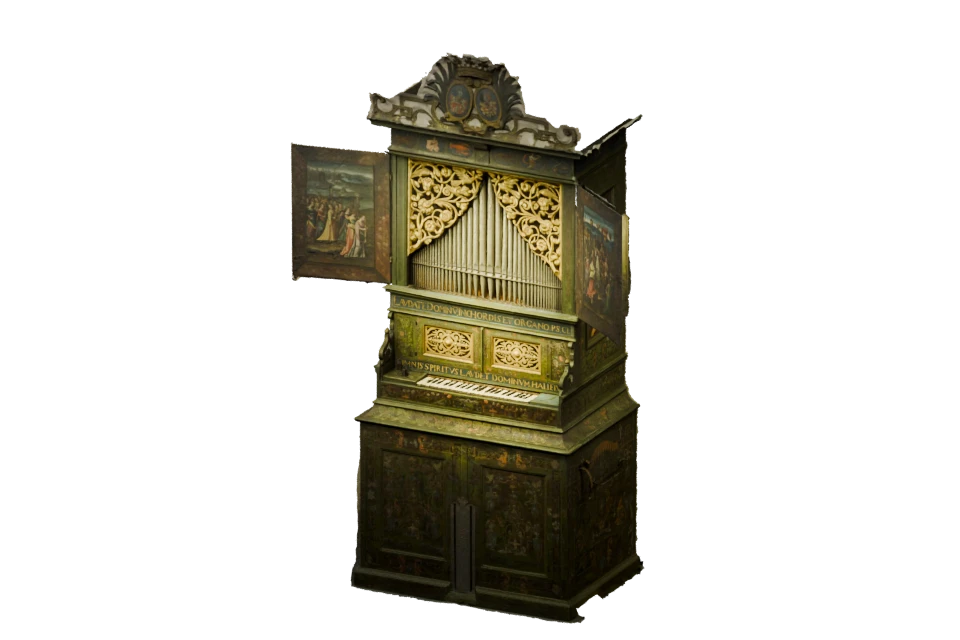
Cuntz positive organ · Leipzig collectionA rendered view of the study model. Source & credits ↗
01 / WHAT THE PROJECT CONTRIBUTES
From scattered sources to connected research.
MODAVIS brings together standards, a shared vocabulary, research data and software. Each solves a different part of the same problem: keeping digital work understandable, traceable and reusable.
Connect a recording, a model and their evidence in one documented research object. The linked resources keep their own formats.
Inspect VAO Standard
The guides, teaching carriers and browser validator use VAO 0.6.0. It adds MMIC 1.0.0 for documented mechanical music carriers. Browser checks cover the generic package; native tools validate MMIC. Neither check establishes historical accuracy.
Give relationships a precise meaning: distinguish the instrument, its changing state, a digital representation and the sources behind a claim.
Inspect MODAVIS Ontology Network
Object · State · Claim · Source
The guides use MODAVIS 0.1.0, a network of 14 ontology modules. Browser graph checks use its exchange profile; a valid graph does not establish historical truth.
Bring organ records from different collections into a connected corpus, with their sources and competing descriptions still identifiable.
Inspect Pipe Organ Dataset
This POD 1.6.0 release includes 11,778 actors, 203,831 places and 897 virtual instruments. These are corpus counts, not a complete census of surviving organs. Coverage and source attribution matter.
Use Navigator to follow instruments through their sources, people and histories. Use OrgRec to plan, capture and inspect documented recordings.
Inspect Research tools
OrgRec supports specification-bound recording plans and multichannel capture on macOS. Software versions, availability and access terms are documented separately for each tool.
02 / LOOK, LISTEN, QUESTION
One instrument. Several kinds of evidence.
The Cuntz positive organ, attributed to Nicolaus Cuntz in 1610, offers a concrete way into MODAVIS. A recording, a model and an observation each reveal something different.
The research lies in connecting them—and making clear what each can tell us.
Recording, data curation, VAO production and maintenance: Dominik Ukolov; measurements: Philipp Hosbach; TASTEN and DISKOS coordination: Dr. Heike Fricke; project leadership: Prof. Dr. Josef Focht; restoration: Markus Brosig and Veit Heller; institution: Leipzig University; hosting: Musikinstrumentenmuseum der Universität Leipzig.
The image is a rendered view of a web display derivative of the released model. Textures and geometry were optimized for display; physical scale and historical fidelity were not independently verified.
Listen to a recorded toneGedackt · control note 36
A 9.43-second audition from the released Cuntz dataset. This recording documents a captured sound; it does not establish how the organ sounded in 1610.
Recording, data curation, VAO production and maintenance: Dominik Ukolov; measurements: Philipp Hosbach; TASTEN and DISKOS coordination: Dr. Heike Fricke; project leadership: Prof. Dr. Josef Focht; restoration: Markus Brosig and Veit Heller; institution: Leipzig University; hosting: Musikinstrumentenmuseum der Universität Leipzig.
The OGG is the unchanged released mobile audition. Compatibility WAV: decoded with FFmpeg to 48 kHz stereo signed 16-bit PCM, without intentional gain, trimming or tempo changes. The waveform is a peak envelope across both decoded channels, normalized only for drawing; it is not a calibrated sound-pressure plot.
The software ecosystem supports the journey from finding a source to exploring a published result. Recording and analysis tools connect fieldwork to this wider process.
01 →
Discover
Find relevant sources
Prospector
02 →
Acquire
Keep data with its origins
Aggregator
03 →
Process
Transform and reconcile
Processor
04 →
Preserve
Publish versioned results
Persistor
05 →
Explore
Follow the connections
Navigator
Initiator supplies shared schemas and data governance. Availability and release status are documented separately for each tool.