Inspect the model, understand the representation
A 3D model is a useful way to examine a representation. The Cuntz example shows why its source, transformations, coordinate conventions and scientific limits belong beside the view.
3D STUDY
Cuntz positive organ · a model to inspect
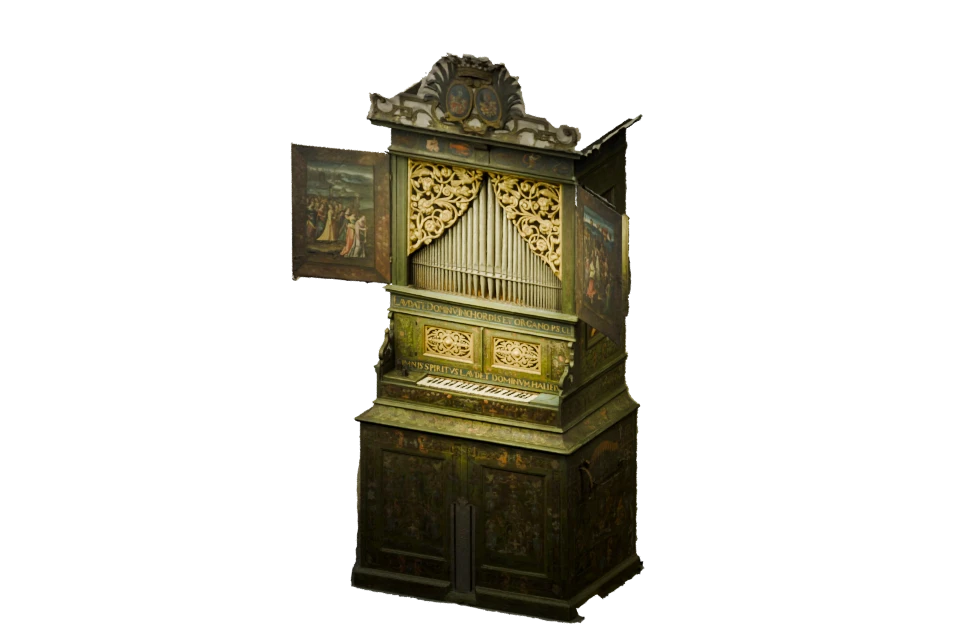
The 3D view loads only when requested. Download: 17.9 MiB.
Drag to rotate; use + and − to zoom. Keyboard: focus the model and use arrow keys, or use the view buttons above. Page scrolling stays available.
Rotate the model to inspect its represented structure. This is a web display derivative of the released GLB, not a calibrated survey or a reconstruction certified as the instrument’s state in 1610. Keyboard and stop controls are visual geometry here; this viewer does not play the instrument.
Recording, data curation, VAO production and maintenance: Dominik Ukolov; measurements: Philipp Hosbach; TASTEN and DISKOS coordination: Dr. Heike Fricke; project leadership: Prof. Dr. Josef Focht; restoration: Markus Brosig and Veit Heller; institution: Leipzig University; hosting: Musikinstrumentenmuseum der Universität Leipzig. · CC BY-SA 4.0
Source, changes & file identity
Web display derivative: texture resized to at most 2048 pixels and encoded as JPEG (quality 85); duplicate and unused resources removed and identical vertices welded; meshopt compression with quantization. No historical geometry or physical scale was independently validated. Source realization: urn:musixplora:4010243:cuntz-positiv:realization:model-runtime:4010243_segmented_03b2. Source SHA-256: 19527c2188b08d8536f00299a76c0c73490748298e6cb4dfa07d5b1b684793f5. The poster is a rendered view prepared from the same display geometry.
Detailed display SHA-256: 6f0dd1a5ea58403da979de9b95ce1232aaf38671d1756ad127a404ba4ae91b47
What can this view tell us?
Cuntz · Worked example#
Is the 3D model the Cuntz organ?
An ontology is an explicit agreement about the kinds of things we describe and the relationships between them. Its first useful distinction here is between an instrument and a representation of it.
The physical Cuntz positive organ is identified as mXp 4010243. The release also contains a geometric model and audio files. They concern the instrument, but each has its own identity.
Work through the example 3 STEPS
Name the physical subject
Use the instrument identity for claims about the organ itself. Its record can link to the museum and to documentary evidence.
Name each representation
Give a model, a recording and a playable software product separate identities. A relationship such as “represents this instrument” connects them without declaring them the same thing.
Follow a change
Compressing the model changes its digital realization. It does not rebuild the museum instrument. Repairing a physical component is a different event and needs its own evidence.
BASIS FOR THIS EXAMPLE
- Cuntz Positiv · VAO 0.5.0-rc.2 ↗
Published manifest: identities, measurement observations, realization digests, profiles and rights. Exact examples checked against this release.
- MODAVIS Ontology Network 0.1.0 ↗
Identity, state, configuration, evidence, assertions, context and provenance. Teaching examples explain its distinctions without inventing new normative properties.
The displayed model is a derived visualization with an unverified physical scale. Being about the Cuntz organ does not make every visible detail a measured historical fact.
The useful distinction. An identity answers “which thing?”; a representation relationship answers “what is this about?”.
Cuntz · Worked example#
Can we measure the original organ by rotating its model?
A coordinate frame defines axes, orientation and units. A verified physical scale additionally requires evidence linking those coordinates to the physical object.
The released model declares a right-handed, Y-up frame with metre units, while its purpose limitation says the source scale has not been verified by a physical survey.
Work through the example 3 STEPS
Read the coordinate convention
The convention tells a renderer how to interpret model coordinates and orient the scene. It helps two applications agree about the same geometry.
Read the qualification
A declared metre unit does not supply a missing calibration. If the original geometry scale was not verified, a distance computed from its vertices must not be advertised as a measured organ dimension.
Use appropriate evidence for dimensions
For a documented pipe quantity, inspect the identified measurement observation and workbook source. Use the model to locate and discuss shapes within its stated limitations.
BASIS FOR THIS EXAMPLE
- Cuntz Positiv · VAO 0.5.0-rc.2 ↗
Published manifest: identities, measurement observations, realization digests, profiles and rights. Exact examples checked against this release.
- VAO Standard 0.5.0 ↗
The standard contract is separate from the Cuntz dataset content version 0.5.0-rc.2.
The notebook deliberately provides viewing controls without a physical measurement ruler.
The useful distinction. Coordinate consistency allows interchange; metrological validity requires additional evidence.
How this display differs from the archived file
Cuntz · Worked example#
How did the model on this page come into being?
Provenance is a trace of inputs, transformations, outputs and responsible agents. PROV-O provides a vocabulary for describing those roles.
The published Cuntz release identifies an FBX source model and a derived GLB runtime model. This notebook displays a further web derivative of that released GLB.
Work through the example 3 STEPS
Fix the input
Before preparing the web model, compare its source bytes and SHA-256 with the exact published runtime realization. A similar filename is insufficient.
Describe the transformation
For this website, the texture is resized to at most 2048 pixels and encoded as JPEG. Duplicate and unused resources are removed, and meshopt compression applies quantization. These changes are documented with the derivative.
Give the output its own identity
The web file has its own byte size and digest. It remains linked to the source release and source realization, while being described as a display derivative rather than the unmodified archived GLB.
BASIS FOR THIS EXAMPLE
- Cuntz Positiv · VAO 0.5.0-rc.2 ↗
Published manifest: identities, measurement observations, realization digests, profiles and rights. Exact examples checked against this release.
- VAO Standard 0.5.0 ↗
The standard contract is separate from the Cuntz dataset content version 0.5.0-rc.2.
Compression and a rendered appearance do not establish geometric measurement accuracy or recover the object’s original appearance.
The useful distinction. A derivative can be useful and traceable without being byte-identical to its source.
Cuntz · Worked example#
What does the model’s SHA-256 prove?
A checksum is a fingerprint calculated from bytes. Fixity checking compares that fingerprint with a trusted expected value to detect changed or mismatched files.
The published GLB source for this notebook has SHA-256 beginning 19527c2188b08d85. The display derivative has a different digest because its texture and encoding were changed.
Work through the example 3 STEPS
Compare like with like
Check the complete source GLB digest against the exact source realization. Compare the website derivative against its own expected digest, not against the source GLB’s digest.
Notice byte-changing edits
A texture conversion or mesh encoding change produces a different file identity. Even reformatting a JSON manifest can change its exact-byte hash without changing its parsed meaning.
Keep the scientific question separate
Matching bytes establish which representation was obtained. The digest does not verify the model’s physical scale, the pipe measurement method or a claim about the sound of 1610.
BASIS FOR THIS EXAMPLE
- Cuntz Positiv · VAO 0.5.0-rc.2 ↗
Published manifest: identities, measurement observations, realization digests, profiles and rights. Exact examples checked against this release.
- VAO Standard 0.5.0 ↗
The standard contract is separate from the Cuntz dataset content version 0.5.0-rc.2.
This website verifies the model’s expected byte length and full SHA-256 before passing it to the renderer. That is a file-identity check, not a VAO conformance report.
The useful distinction. Fixity makes evidence identifiable; it does not independently validate the evidence’s interpretation.
The viewer loads only after you select “Explore in 3D”. The expected byte size and SHA-256 are checked before display. Source attribution and download links remain usable without the 3D view; the poster and explanation are included in print. The camera controls affect only your view, not the source geometry.
Sources & further reading
- Cuntz Positiv · VAO 0.5.0-rc.2
Published manifest: identities, measurement observations, realization digests, profiles and rights. Exact examples checked against this release.
- VAO Standard 0.5.0
The standard contract is separate from the Cuntz dataset content version 0.5.0-rc.2.
Page editions 2026-09-r5 ↓
Read a fixed snapshot of this chapter, or return to the current notebook.
Edition 2026-09-r5 · SHA-256
9eba3c45a21bPage metadata ↗